
How the First Casino “House Rules” Emerged: From Wild West Saloons to Modern Standards (19th–20th Century)
Long before casinos were licensed, inspected, and audited, gambling was mostly governed by whatever rules the room owner decided to enforce. Those early “house rules” were not just about how a game was played — they were a practical response to cheating, disputes, debt, violence, and the simple need to keep business running. From the American frontier saloon to European spa resorts and later the neon-lit casino floors of the twentieth century, the same question kept returning: who sets the rules, and how do players know they are fair?
The Wild West saloon: where house rules were born out of necessity
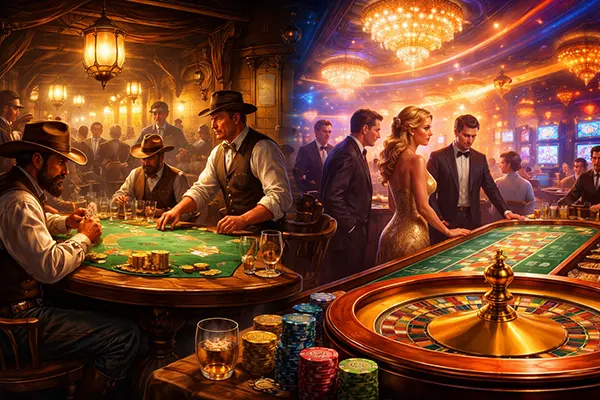
In many nineteenth-century American towns, a saloon was more than a bar — it was a social hub, a makeshift bank, and often the only “entertainment venue” for miles. Gambling tables (especially poker, faro, and various dice games) were commonly placed in the back room or in a dedicated corner. There was no unified legal framework across territories, so each venue enforced its own expectations: what counted as a valid bet, which hands were recognised, whether a player could “string bet,” and how disputes were resolved.
Because cash was not always plentiful, bets could include gold dust, livestock claims, IOUs, or personal valuables. That forced proprietors to create rules on acceptable stakes and how debt would be handled. Some saloons required immediate settlement of losses; others allowed credit but imposed strict limits to prevent violent confrontations. This wasn’t “formal regulation” — it was business self-defence, written in chalk on boards, spoken aloud by the dealer, or simply enforced by reputation and intimidation.
Cheating was widespread enough that many saloons adopted preventative customs that later became standard procedures. Dealers began insisting on visible hands, clear dealing motions, and restricted seating. Some rooms introduced “house cuts” or mandatory dealer tips that functioned like an early rake. Even the idea that the house could remove a disruptive player without refunding bets became part of the unwritten rulebook — a pattern that survived into modern casino terms and conditions.
Disputes, security, and the earliest forms of enforcement
When disagreements happened in frontier gambling rooms, there was rarely a neutral authority. A dealer might be the judge, but only if the room trusted him. In some saloons the owner made final decisions, and if his word was questioned, the next step could be violence. That reality shaped early house rules more than any sense of “fair play”: rules had to be simple, fast to apply, and impossible to debate for long.
Many venues relied on informal security — hired “bouncers” or simply armed staff. House rules therefore included behavioural control: no weapons on the table, no touching cards once they were dealt, no arguing with the dealer, and no interfering with another player’s chips. These aren’t romantic details; they are the roots of modern casino etiquette and conduct policies, including the right to refuse service.
As towns grew and law enforcement became more present, gambling rooms gradually learned that written rules reduced conflict. Posting a short list of table conditions helped prevent claims of “the dealer changed the rules mid-game.” By the late nineteenth century, some higher-end venues already treated rule clarity as part of customer trust — an early sign of the shift from brute enforcement to procedural authority.
European gaming rooms: from local custom to printed rulebooks
While frontier America was improvising, Europe had long traditions of organised gambling, especially in aristocratic circles and resort towns. Places such as Baden-Baden, Spa, and Monte Carlo attracted wealthy visitors who expected polished service and predictable rules. Here, “house rules” evolved not from chaos, but from the need to protect prestige and ensure consistency for international guests who might otherwise challenge outcomes.
Games like roulette and chemin de fer required more structure than many frontier card games. Roulette, for example, depends on precise procedures: when bets close, who spins, how results are confirmed, and how payouts are calculated. European houses refined these steps and published them. This is one of the earliest settings where rule sheets and printed notices became a normal feature of gambling venues, rather than an occasional sign on a wall.
Importantly, European casinos also popularised the idea that the house edge should be built into the game rules, not improvised by the dealer. In roulette, the single zero (and later the double zero in some variants) functioned as a rule-based mathematical advantage, rather than a “fee” taken by the dealer. That principle — that the casino earns through odds and procedure — later became central to modern regulated gambling.
Standardising games: why the same rules mattered across borders
By the late nineteenth and early twentieth centuries, travel became easier for the wealthy, and gambling tourists compared experiences. If a player learned roulette in one resort and discovered different payout handling elsewhere, trust suffered. This encouraged leading venues to align procedures and to adopt detailed staff training, so that games ran identically from table to table. What started as local house custom gradually became an emerging set of shared standards.
Card games also became more formal. Rules around shuffling, cutting, dealing order, and how to handle exposed cards were increasingly written down. That reduced accusations of manipulation and helped owners hire staff who could work reliably without “inventing” their own method. In modern terms, this was an early form of operational compliance — not driven by law yet, but by reputation and competition.
European casinos further shaped the social side of house rules: dress expectations, acceptable behaviour, and the separation of gambling spaces from general public areas. These rules were not purely moral — they were commercial positioning. The more controlled and upscale the environment, the more players were willing to stake, and the less likely disputes were to erupt publicly.
The twentieth century: licensing, audits, and modern standards of fairness
In the twentieth century, the biggest change was that house rules stopped being purely “house” decisions. Governments began licensing and regulating gambling more systematically, especially as states realised casinos could be taxed and controlled rather than simply tolerated or banned. Over time, rules became tied to law, and casinos had to prove that games operated according to approved procedures.
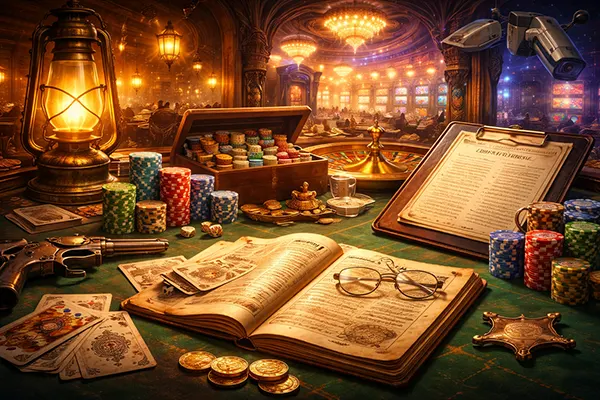
One major milestone was the professionalisation of casino oversight. In jurisdictions where casinos were legal, regulators required documented internal controls: how cash is handled, how dealers are trained, how disputes are logged, and how suspected cheating is reported. This transformed the idea of “house rules” into a structured rule system — sometimes including rulebooks for players, internal manuals for staff, and inspection-ready procedures for authorities.
Technology accelerated this shift. Mechanical shufflers, surveillance cameras, and later computerised tracking systems changed how casinos enforced rules. A decision no longer relied only on the dealer’s memory; it could be reviewed. By the late twentieth century, many casinos operated with layered enforcement: table rules, management policies, and regulatory requirements working together.
What modern house rules still inherit from the past
Even in 2026, many familiar casino rules reflect nineteenth-century problems in a cleaner form. Limits on bet sizes exist partly for risk management, but also to prevent disputes and volatility at a table. Clear dealing procedures, fixed payout rules, and the authority of the pit boss all echo the original goal: keep the game stable and keep conflict from escalating.
Modern standards also preserve the old tension between player freedom and house control. Casinos still reserve the right to refuse service, remove disruptive patrons, or void bets under defined conditions — but today these actions are typically tied to written policies and, in regulated markets, must be defensible under licensing requirements. The principle remains the same as the saloon era: the venue must protect its operation first, but now it does so through documented procedure rather than intimidation.
Finally, contemporary rule sets increasingly include consumer protection and responsible gambling measures, especially in regulated environments. That layer did not exist in the Wild West or early European resorts, but it grew throughout the late twentieth century and continues to expand. In that sense, modern “house rules” are no longer only about protecting the casino; they also reflect wider public expectations of fairness, transparency, and harm reduction.