
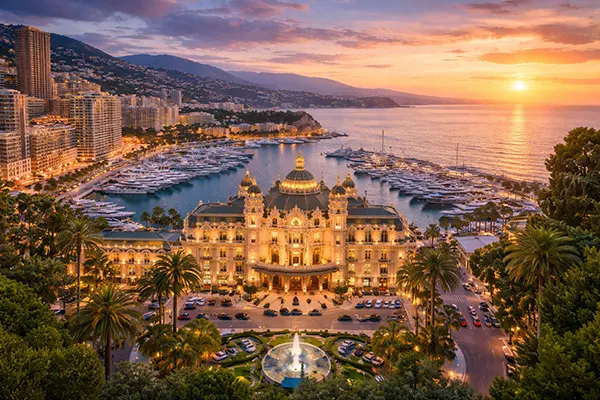
When Casino Became Geopolitics: Monte Carlo and Monaco’s Turn into a Financial Centre
Monte Carlo’s casino is often treated as a symbol of glamour, but its more durable role has been political: it gave a tiny state a repeatable revenue stream, bargaining power with neighbours, and a way to finance legitimacy. From the 1860s onward, Monaco used gambling, town planning, and carefully drafted agreements to survive territorial loss, fund infrastructure, and later reposition itself as a specialist hub for private wealth. By 2026, the story is no longer “casino money saved a principality” but “casino capital helped engineer a modern financial ecosystem”, with all the scrutiny that comes with that shift.
1860s foundations: a casino as a state project, not just entertainment
In the early 1860s Monaco’s finances were fragile, and the state’s room for manoeuvre was limited. The decision to grant a gambling concession and organise it through a dedicated company was not a side hustle; it was a deliberate fiscal strategy. The Société des Bains de Mer (SBM) was created in 1863 by sovereign act under Prince Charles III, binding the casino’s fortunes to the state’s survival and to an emerging district built specifically to host visitors and their money.
The arrangement worked because it combined monopoly economics with place-making. The concession did more than permit gambling; it aligned hotels, entertainment, and urban design around predictable inflows of wealthy seasonal guests. In practice, the casino became an anchor client for infrastructure: roads, public works, and services that a small state could not otherwise finance at that scale. The result was a virtuous circle for Monaco: more visitors funded better amenities, which attracted more visitors, which made the concession more valuable.
Crucially, this was also a reputational project. Monte Carlo was branded as a destination associated with discretion, safety, and high social status. That branding mattered geopolitically: it positioned Monaco as a neutral, desirable enclave on the Côte d’Azur, with an economy linked to international elites rather than to a single industrial base. Even before “financial centre” became the label, the state was learning how to convert external wealth into domestic resilience.
François Blanc, the concession model, and why monopoly mattered
The business architecture of Monaco’s casino era is inseparable from the figure of François Blanc, brought in to make the project bankable and operational. The concession model created a clear exchange: the operator gained privileged rights to gambling; the state gained a structured stream of income and a partner committed to building the wider resort economy. In modern terms, Monaco outsourced execution while keeping strategic control over the asset that generated fiscal oxygen.
Monopoly mattered because it reduced volatility and prevented a “race to the bottom” between competing venues. A single operator could plan decades ahead—hotels, venues, customer experience—while the state could forecast revenues more reliably than it could from customs or small-scale trade. That predictability is what turned gambling from mere leisure into governance: it funded public capability without requiring a large domestic tax base.
This early framework also set a long-run precedent: Monaco would repeatedly pair targeted economic privileges with tight geographic concentration. First it was gambling rights; later it became residency rules, corporate presence requirements, and financial supervision. The continuity is striking: Monaco’s advantage was never size, but the ability to design rules that made scarce territory economically dense.
Tax, treaties, and statecraft: turning revenue into a competitive fiscal identity
The casino’s success did not simply fill the treasury; it created political space to shape a distinctive tax identity. Monaco is widely associated with the absence of personal income tax for residents, a policy introduced in the nineteenth century and still central to its appeal. Over time, this choice helped move Monaco’s value proposition away from gaming alone and toward residency, services, and high-end real estate—each reinforcing the other.
Yet this fiscal identity has never existed in a vacuum. Monaco’s sovereignty is real, but it is exercised alongside negotiated constraints, especially with France. French nationals resident in Monaco are treated differently for income tax purposes under bilateral arrangements, and those arrangements reflect broader geopolitical realities: Monaco’s economic model must be tolerated by its neighbours, not merely declared by statute.
By the late twentieth and early twenty-first centuries, the casino’s relative importance as a single revenue engine diminished compared with the wider ecosystem it helped create: banking, wealth management, professional services, and property. That transition matters because it changes the type of scrutiny Monaco faces. A casino can be framed as tourism; a financial centre is judged on governance, transparency, and controls—standards set outside Monaco as much as inside it.
Income tax absence and the French exception: incentives with boundaries
Monaco’s lack of personal income tax for most residents is often described as a simple magnet for wealth, but it functions more like a pillar in a larger system. It supports demand for residency, which supports real estate values, which supports construction and local employment, which supports a service economy that caters to high-net-worth households. The casino provided early capital and brand power; tax policy helped lock in the long-term residency angle.
The French exception is the reminder that geopolitical bargaining is never optional. French nationals in Monaco are subject to specific rules under agreements between the two countries, reflecting historical pressure and the need for France to protect its own tax base. This carve-out is not a footnote: it shows how Monaco’s model is sustained by legal interoperability and by concessions that reduce conflict with a much larger neighbour.
For Monaco, the practical lesson has been to pursue incentives that can survive external review. The state tends to emphasise “genuine establishment” and real presence—residency requirements, local activity, and regulatory supervision—because these features help defend the model as more than paper. In 2026, that defensive posture is even more important, given how aggressively international bodies evaluate small jurisdictions that specialise in cross-border wealth.

From casino economy to financial centre: what the numbers and institutions show by 2026
By the mid-2020s, Monaco’s financial sector is routinely described with metrics that look like those of a dedicated wealth hub, not a resort town. Industry figures published by Monaco’s financial community report that, at the end of December 2024, the financial centre comprised 92 firms representing around €100 billion in assets under management and/or advisement from Monaco, with deposits and securities totalling about €172 billion. Those are large numbers for a state of Monaco’s size, and they indicate that the “casino brand” has been converted into a durable wealth-services proposition.
The institutional ecosystem also reads like a specialised centre: private banks (often as branches of foreign groups), portfolio management companies, family-office services, trust and estate planning expertise, and a professional services layer that supports cross-border structures. The casino still matters culturally and commercially, but its more significant role is historical: it financed the initial build-out and made Monaco a credible home for discretion-driven services.
At the same time, financial scale brings financial-centre obligations. Monaco is expected to align with international anti-money laundering and counter-terrorist financing standards, to supervise risk-based compliance, and to demonstrate enforcement outcomes. In the 2020s, the direction of travel is clear: Monaco wants to be seen as a serious, rules-based centre for private wealth, not a romantic loophole.
Compliance pressure in the mid-2020s: why geopolitics returned to the story
International oversight became especially visible after Monaco was placed under increased monitoring by the Financial Action Task Force (FATF) in June 2024—commonly called the “grey list”. This was not a judgement that Monaco is uniquely problematic; rather, it signalled that specific strategic deficiencies needed to be addressed within agreed timelines, and that progress would be tracked publicly. For a jurisdiction whose business depends on trust, reputational signals like this have direct economic consequences.
European scrutiny also tightened. In June 2025, the European Commission updated its list of high-risk third-country jurisdictions for AML/CFT purposes and added Monaco to the list, triggering enhanced vigilance requirements for covered EU entities in transactions involving Monaco-linked counterparties. This kind of listing affects friction and cost: additional checks, slower onboarding, and more documentation—exactly the issues a wealth hub tries to minimise without weakening safeguards.
Monaco’s response has been to treat compliance as part of competitiveness. The logic is geopolitical in the modern sense: access to European and global financial systems depends on alignment with shared standards and on credible supervision. In other words, the same statecraft that once turned a casino concession into a fiscal lifeline is now being applied to regulation, transparency, and institutional credibility—because, by 2026, the real game is confidence.