
History of Roulette: From Early Wheel Experiments to Salon Classic
Roulette did not appear in casinos as a finished and polished game. Its story began with mechanical curiosity, mathematical debate and repeated attempts to regulate risk. By 2026, roulette remains one of the most recognised casino tables in both land-based venues and regulated online environments, yet its structure still reflects decisions taken centuries ago. The development of the wheel, the stabilisation of rules and the professionalisation of the dealer’s role shaped the version of roulette that players recognise today. Understanding that evolution explains why different wheel formats exist and why modern gaming standards are so carefully defined.
Early Prototypes and the Stabilisation of Rules
The origins of roulette are usually linked to 17th-century France and the experiments of Blaise Pascal, who attempted to construct a perpetual motion machine. While his mechanical wheel was not designed as a gambling device, it contributed to the idea of a rotating numbered disc. By the early 18th century, French gaming houses combined elements of older games such as Roly-Poly, Even-Odd and Biribi into a more structured wheel game. At that stage, layouts were inconsistent, and some wheels featured both a single zero and a double zero, dramatically increasing the house advantage.
Throughout the 18th and early 19th centuries, roulette lacked uniform regulation. In Parisian gambling salons, wheel numbering sequences varied, and betting layouts were not fully standardised. The presence of both 0 and 00 often resulted in a house edge exceeding 5%. It was not until 1843 that François and Louis Blanc introduced the single-zero wheel in Bad Homburg, Germany. By removing the double zero, they reduced the mathematical advantage to approximately 2.7%, making the game more attractive to players and commercially sustainable.
The Blanc brothers’ innovation proved decisive. When roulette returned to France under Napoleon III’s liberalised gambling policies, the single-zero version became the dominant European model. Over time, numbering sequences were fixed to balance high and low, odd and even numbers around the wheel, minimising visual clustering. These adjustments were not aesthetic; they were intended to reinforce player trust and prevent suspicion of manipulation.
Why Different Wheel Variants Emerged
The divergence between European and American roulette is rooted in economic competition. When roulette crossed the Atlantic in the 19th century, American gambling operators reintroduced the double zero to increase profitability. The resulting 38-slot wheel (numbers 1–36, 0 and 00) created a house edge of 5.26%, nearly double that of the European format. This difference remains one of the clearest mathematical distinctions in modern casino gaming.
In the 20th century, further adaptations appeared. French roulette retained the single zero but introduced rules such as “La Partage” and “En Prison”, which reduce player losses on even-money bets if the ball lands on zero. These mechanisms lower the effective house edge to about 1.35% on qualifying bets. Such refinements illustrate how regulatory environments and competitive pressures shaped rule variations rather than random experimentation.
By 2026, additional formats exist in regulated markets, including triple-zero roulette in certain North American jurisdictions. This 39-slot version increases the house edge to roughly 7.69%. Its appearance reflects commercial strategy rather than historical continuity. Meanwhile, European regulators continue to prioritise single-zero wheels in licensed venues, preserving the traditional balance between operator margin and player value.
The Evolution of the Dealer’s Role and Gaming Standards
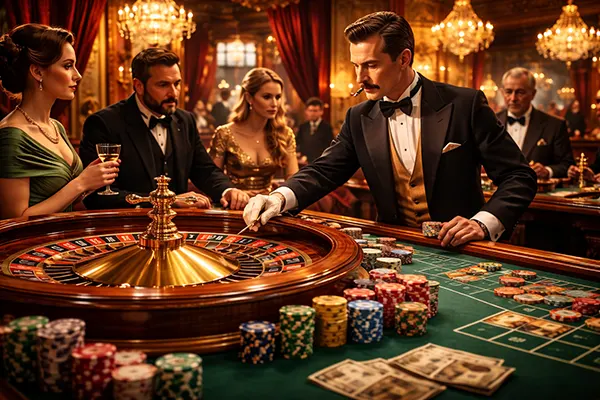
In early gambling houses, the individual operating the wheel often combined several roles: wheel spinner, stake collector and dispute resolver. There were few formal procedures. As roulette became central to 19th-century casino culture in Monte Carlo, the role of the croupier was formalised. Staff were trained to spin the wheel consistently, announce bets clearly and manage chips with visible precision to prevent allegations of bias.
Standardised gestures developed over time. The announcement “No more bets” became a formal signal marking the closure of wagering. Hand movements for collecting losing chips and paying winners were designed to remain within players’ sightlines. These conventions, still followed in 2026, exist to ensure transparency and protect both the casino and its customers from misunderstandings.
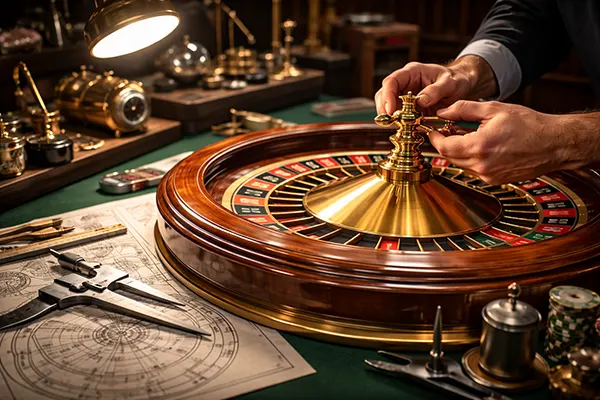
The 20th century introduced surveillance systems, internal auditing procedures and strict equipment calibration. Modern roulette wheels are engineered with high precision tolerances, often produced by specialised manufacturers using balanced rotors and frets designed to randomise ball movement. Regulatory bodies in Europe require certification to confirm that wheels meet fairness standards and that electronic recording systems accurately track outcomes.
Professionalisation in the Digital Era
The expansion of live casino streaming in the 2010s and 2020s added another layer to the dealer’s responsibilities. Live croupiers now operate under studio conditions with high-definition cameras, real-time monitoring and multi-jurisdiction compliance checks. Their conduct is governed by licensing authorities such as the UK Gambling Commission and the Malta Gaming Authority, which enforce strict operational protocols.
In online live environments, the dealer’s actions are synchronised with digital betting interfaces. Timing is precisely regulated: betting windows, spin duration and result confirmation follow software-controlled sequences. This integration reduces human error while preserving the visual authenticity associated with traditional roulette tables.
By 2026, roulette dealers are trained not only in mechanical procedure but also in responsible gambling awareness. They are expected to recognise signs of distress or excessive play in certain regulated settings and to escalate concerns where appropriate. The role has therefore shifted from purely mechanical operation to part of a broader compliance framework designed to uphold fairness and consumer protection.
Roulette as a Salon Institution and Cultural Symbol
Roulette’s association with refined salon culture emerged in the 19th century, particularly in Monte Carlo. The controlled pace of the game, the physical elegance of the wheel and the ritualised movements of the croupier contributed to its reputation as a social spectacle. Unlike faster card games, roulette encouraged observation and conversation between spins.
Literature and cinema reinforced this image. Writers such as Fyodor Dostoevsky, who drew on his own experiences in European gambling houses, depicted roulette as a stage for psychological tension. These portrayals influenced public perception, embedding roulette within broader discussions about risk, probability and personal discipline.
In contemporary licensed casinos, roulette tables often occupy prominent positions on the gaming floor. Their design reflects both heritage and modern safety requirements. Materials, lighting and layout are carefully considered to ensure visibility, accessibility and compliance with current health and safety standards.
Continuity and Regulation in 2026
Despite technological evolution, the core mechanics of roulette remain stable: a numbered wheel, a spinning ball and a fixed payout structure based on probability. The mathematical foundations established in the 19th century continue to determine house advantage calculations in 2026. This continuity reinforces trust, as players can independently verify odds.
Regulatory oversight has become more comprehensive. Certified testing laboratories evaluate wheel bias, while digital systems record outcomes for audit purposes. In many jurisdictions, public reporting obligations require operators to demonstrate compliance with fairness standards and responsible gaming policies.
From experimental mechanical wheels to regulated global gaming institutions, roulette’s journey reflects a constant negotiation between chance and control. Its endurance lies not in mystique but in transparent mathematics, stable rules and professional standards that have evolved over centuries without abandoning the fundamental structure that first captured attention in European salons.